Getting people to notice your business online is only the first step. The bigger challenge is turning that attention into real conversations, enquiries, and potential customers.
A business can have a website, social media accounts, and regular content but still struggle with a simple question: how to generate leads online consistently?
The good news is that lead generation does not depend on one platform or one marketing tactic. Businesses can combine content, search, social media, landing pages, email, referrals, advertising, and other channels to build a predictable system for attracting potential customers.
In 2026, this process is becoming even more multi-channel. People are discovering businesses through traditional search, social platforms, video, maps, and increasingly AI-powered search experiences. Google has also expanded Search Console reporting around multimodal search, showing how search is moving beyond traditional text queries.
In this guide, you’ll learn 15 practical strategies to generate leads online, how to choose the right methods for your business, how to measure performance, and how to turn more of your online visitors into genuine prospects.
What Is Online Lead Generation?
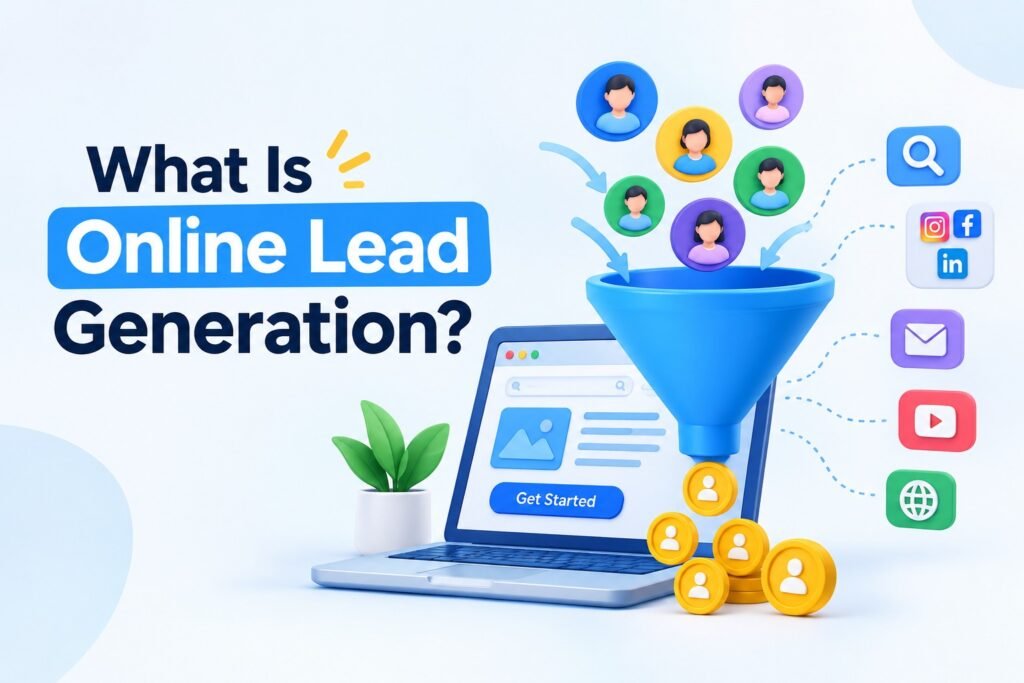
Online lead generation is the process of attracting people who may be interested in your product or service and encouraging them to take a meaningful action.
That action could be:
- Filling out a contact form
- Requesting a quotation
- Booking a consultation
- Signing up for an email list
- Downloading a guide
- Registering for a webinar
- Sending a WhatsApp message
- Calling your business
- Creating an account
- Requesting a product demonstration
A lead is not automatically a customer.
For example, someone may visit your website and download a free guide. That person has shown interest, but they have not necessarily decided to buy anything.
The basic journey looks like this:
Attract → Engage → Capture → Nurture → Convert
1. Attract
Bring the right audience to your business through search engines, social media, content, advertising, referrals, or other channels.
2. Engage
Give visitors useful information that answers their questions and builds interest.
3. Capture
Give interested visitors a clear opportunity to become leads through a form, consultation, newsletter, offer, or other conversion point.
4. Nurture
Follow up with useful information and help the prospect understand your offer.
5. Convert
When the prospect is ready, move them toward a purchase, booking, enquiry, or another business goal.
The goal is therefore not simply to generate more traffic. It is to attract the right traffic and create a clear path from attention to action.
15 Strategies to Generate Leads Online in 2026
1. Create Content That Solves Real Customer Problems
One of the most sustainable ways to generate leads is to create content around the questions your target customers are already asking.
Instead of constantly talking about your business, create content that helps people solve problems.
For example, a real estate company could publish:
- How to choose a property for investment
- Questions to ask before buying a home
- Common mistakes first-time buyers make
- How much money should you save before buying a property?
A fitness business could create:
- Beginner workout guides
- Healthy meal-planning tips
- Common exercise mistakes
- How to build a sustainable fitness routine
The key is to connect useful information with the problems your potential customers actually have.
How to implement it
- List the top questions customers ask.
- Research related search queries.
- Group questions into topics.
- Create detailed articles, videos, or social posts.
- Add a relevant next step for interested readers.
Don’t create content simply because a keyword has search volume. Create content because it provides a useful answer.
2. Optimize Your Website for Lead Generation
Your website should not only explain what your business does. It should make it easy for interested visitors to take action.
A visitor should quickly understand:
- What you offer
- Who you help
- Why your business is relevant
- What they should do next
Important conversion elements include:
- Clear headlines
- Strong calls-to-action
- Simple contact forms
- Trust signals
- Customer reviews
- Relevant case studies
- Frequently asked questions
- Easy navigation
- Mobile-friendly design
For example, instead of ending a page with nothing, you could provide a simple CTA such as:
“Want to discuss your requirements? Book a consultation.”
The CTA should match the visitor’s intent rather than aggressively pushing them to buy.
3. Use SEO to Attract High-Intent Visitors
Search engines can connect your business with people who are actively looking for information, solutions, or products.
This makes SEO an important part of how to generate leads online, particularly for businesses that want long-term organic visibility.
Start by understanding search intent.
Someone searching:
“what is digital marketing?”
has a different level of intent from someone searching:
“digital marketing agency for small business”
The first person may simply be learning. The second may be closer to contacting a provider.
Your SEO strategy should therefore target different stages of the customer journey.
Create content for:
- Awareness
- Consideration
- Comparison
- Decision
Also focus on helpful, original content rather than producing large quantities of repetitive pages. Google’s 2026 documentation continues to emphasize Search quality and spam policies across traditional and generative search experiences.
4. Create Dedicated Landing Pages
Sending every visitor to your homepage is not always the best approach.
A dedicated landing page can focus on one audience, offer, campaign, or goal.
For example:
Campaign: Free business consultation
Landing page: A page explaining the consultation, its benefits, what the visitor will receive, and how to request it.
A good landing page should have:
- One clear purpose
- A relevant headline
- Short supporting copy
- Benefits
- Trust elements
- A simple CTA
- Minimal distractions
The page should answer the visitor’s basic questions before asking for their information.
5. Use Social Media to Build Demand
Social media is not only for gaining followers.
It can help businesses:
- Build awareness
- Educate potential customers
- Demonstrate expertise
- Answer questions
- Build trust
- Start conversations
- Drive traffic to conversion pages
In 2026, customer journeys are increasingly spread across multiple platforms. Research from BCG notes that social media remains an important touchpoint for reaching and influencing consumers in Asia, while social platforms are increasingly integrated with commerce.
Instead of posting only promotional content, use a balanced content mix:
Educational + Demonstration + Proof + Engagement + Promotion
For example, a software company could show a common customer problem, explain how to solve it, demonstrate its approach, and then provide a relevant CTA.
6. Use Short-Form Video Content
Short-form video can help businesses communicate an idea quickly and show their personality, expertise, products, or results.
Potential formats include:
- Quick tutorials
- Before-and-after demonstrations
- Frequently asked questions
- Product explanations
- Customer problems and solutions
- Industry tips
- Behind-the-scenes content
- Myth vs. fact videos
The goal isn’t simply to make videos go viral.
A better goal is to attract people who are actually relevant to your business.
For example, a wedding photographer could create a video titled:
“3 Things Couples Should Ask Before Booking a Wedding Photographer.”
Someone who finds that useful is much more relevant than a random viewer who watches an entertaining video unrelated to the business.
7. Offer a Useful Lead Magnet
A lead magnet is something valuable you give a visitor in exchange for their contact information.
Examples include:
- Checklist
- E-book
- Template
- Calculator
- Industry report
- Guide
- Worksheet
- Free resource
- Webinar registration
The lead magnet should solve a specific problem.
For example:
Weak offer:
“Download Our Marketing PDF”
Stronger offer:
“Download the Small Business Instagram Content Checklist”
The second offer tells the visitor exactly what they will receive and why it could be useful.
8. Build an Email List
Email remains useful because you are building a direct communication channel with people who have already shown interest.
A simple lead-nurturing sequence could look like:
Email 1: Deliver the promised resource
Email 2: Provide a useful tip
Email 3: Explain a common problem
Email 4: Share an example or case study
Email 5: Introduce a relevant offer or next step
The purpose isn’t to send promotional emails every day.
Instead, provide enough value that subscribers recognize your business as a useful source of information.
9. Use Webinars, Workshops, and Free Events
Educational events can work particularly well for businesses with products or services that require explanation.
You could offer:
- Online workshops
- Live demonstrations
- Educational webinars
- Q&A sessions
- Industry sessions
- Free training
For example, a financial consultant could host:
“How to Create a Business Budget for the Next 12 Months.”
Participants who register provide an indication of interest.
After the event, businesses can continue the conversation with useful follow-up content.
10. Use Reviews and Social Proof
People often want evidence that a business can deliver what it promises.
Social proof can include:
- Customer reviews
- Testimonials
- Case studies
- Client stories
- Portfolio examples
- Ratings
- User-generated content
Instead of simply saying:
“We provide high-quality service.”
Show evidence of the experience customers have had.
A useful case study can explain:
Problem → Approach → Implementation → Outcome
Avoid inventing results or presenting unsupported numbers.
Trust is particularly important when people are discovering businesses through unfamiliar search environments and AI-powered recommendations.
11. Improve Your Calls-to-Action
A call-to-action tells the visitor what to do next.
Examples include:
- Get a Quote
- Book a Consultation
- Download the Guide
- Request Information
- Start a Free Trial
- Contact the Team
- Get the Checklist
A CTA should be specific.
Compare:
“Submit”
with:
“Get My Free Website Checklist”
The second communicates what happens after the click.
However, the CTA should match the user’s intent.
Someone reading an introductory educational article may not be ready to book a sales call. A softer CTA such as downloading a guide may be more appropriate.
12. Use Retargeting to Reconnect With Interested Visitors
Not everyone converts during their first visit.
Someone might:
- Read your article
- Visit your product page
- Check your pricing
- Leave your website
- Return several days later
Retargeting can help businesses reconnect with eligible visitors through advertising platforms.
For example, someone who viewed a particular product page could later see an advertisement related to that product.
However, retargeting should be handled carefully.
Avoid excessive frequency and make sure advertising follows applicable privacy, consent, and platform requirements.
13. Build Strategic Partnerships
You don’t always have to find every lead yourself.
Businesses can work with complementary companies that already serve the same target audience.
For example:
Web designer + photographer
Accountant + business consultant
Real estate agent + home interior company
Wedding planner + photographer
The businesses are not necessarily direct competitors, but their audiences overlap.
Possible partnership activities include:
- Referral agreements
- Joint webinars
- Collaborative content
- Events
- Bundled offers
- Cross-promotion
The important part is to make sure the partnership provides genuine value to both audiences.
14. Build a Referral System
Satisfied customers can become an important source of new business.
Instead of simply hoping customers recommend you, create a clear referral process.
For example:
- Deliver a good customer experience.
- Ask satisfied customers for feedback.
- Make referrals easy.
- Provide a simple referral message or link.
- Thank people who refer others.
A referral can be valuable because the new prospect often arrives with some level of trust already established.
Don’t rely only on incentives. A strong customer experience is the foundation of a sustainable referral system.
15. Track, Test, and Improve Your Funnel
You cannot improve what you do not measure.
Track the journey from visitor to lead and eventually to customer.
For example:
10,000 visitors → 500 leads → 100 qualified leads → 20 customers
Now you can identify where improvement is needed.
Maybe traffic is strong but the landing page converts poorly.
Or perhaps the website generates many leads but very few are qualified.
Instead of asking only, “How can we get more leads?”, ask:
“Where are potential customers dropping out of the journey?”
This shift can make lead generation much more efficient.
How to Get Leads in Digital Marketing
If you are specifically researching how to leads in digital marketing, start by understanding that lead generation is not one single activity.
A digital marketing lead can come from:
- Search engines
- Social media
- Content
- Paid advertising
- Referrals
- Websites
- Landing pages
- Online communities
- Webinars
The right combination depends on your audience and business model.
For example, a local service business may benefit from local search visibility and social proof, while a B2B company may rely more heavily on educational content, LinkedIn, email, and industry partnerships.
The important question is not simply how to leads in digital marketing, but how to consistently attract the right audience and give them a reason to take the next step.
How to Get Leads for a Digital Marketing Agency
If you’re trying to understand how to get leads for digital marketing agency businesses, focus on demonstrating expertise rather than repeatedly telling people that your agency is good.
A digital marketing agency can attract potential clients through:
Educational Content
Publish content that answers questions business owners actually have.
Examples:
- Why is my website not getting traffic?
- Why is my Instagram account not growing?
- Why are my ads getting clicks but no enquiries?
- How can a small business improve its online presence?
Case Studies
Show how you approached a real problem and what happened.
Social Media
Share useful marketing insights, examples, audits, explanations, and industry observations.
Search Visibility
Create useful content around problems potential clients are actively searching for.
Referrals
Build relationships with existing clients and complementary professionals.
Networking
Participate in relevant business communities and events.
For an agency, how to get leads for digital marketing agency clients is ultimately about building trust before asking for the sale.
How to Find Leads for Digital Marketing
When learning how to find leads for digital marketing, start by defining your ideal customer.
Ask:
- What industry are they in?
- What size is the business?
- What problem are they facing?
- Where do they spend time online?
- What information do they search for?
- What would make them contact a provider?
Once the audience is clear, look for relevant prospects through:
- Google searches
- Business directories
- Industry communities
- Social platforms
- Local business listings
- Networking groups
- Referrals
- Existing customer networks
Avoid collecting thousands of random contacts.
A smaller list of businesses that actually match your target audience can be more useful than a huge database of irrelevant prospects.
How to Generate Leads Online With a Small Budget
You don’t necessarily need a large advertising budget to start.
Here’s how common approaches compare:
| Method | Cost | Difficulty | Time to Results | Best For |
|---|---|---|---|---|
| SEO | Low–Medium | Medium–High | Longer term | Sustainable organic visibility |
| Content Marketing | Low–Medium | Medium | Medium–Long | Education and authority |
| Social Media | Low | Medium | Medium | Awareness and engagement |
| Email Marketing | Low | Medium | Medium | Nurturing existing prospects |
| Referrals | Low | Low–Medium | Variable | Trust-based growth |
| Partnerships | Low | Medium | Medium | Reaching related audiences |
| Paid Ads | Medium–High | Medium | Potentially faster | Testing and targeted acquisition |
A small business can start with a combination of content, social media, SEO, email, and referrals before investing heavily in paid acquisition.
The important thing is to measure what happens after the lead is generated.
Free vs Paid Lead Generation: Which Should You Use?
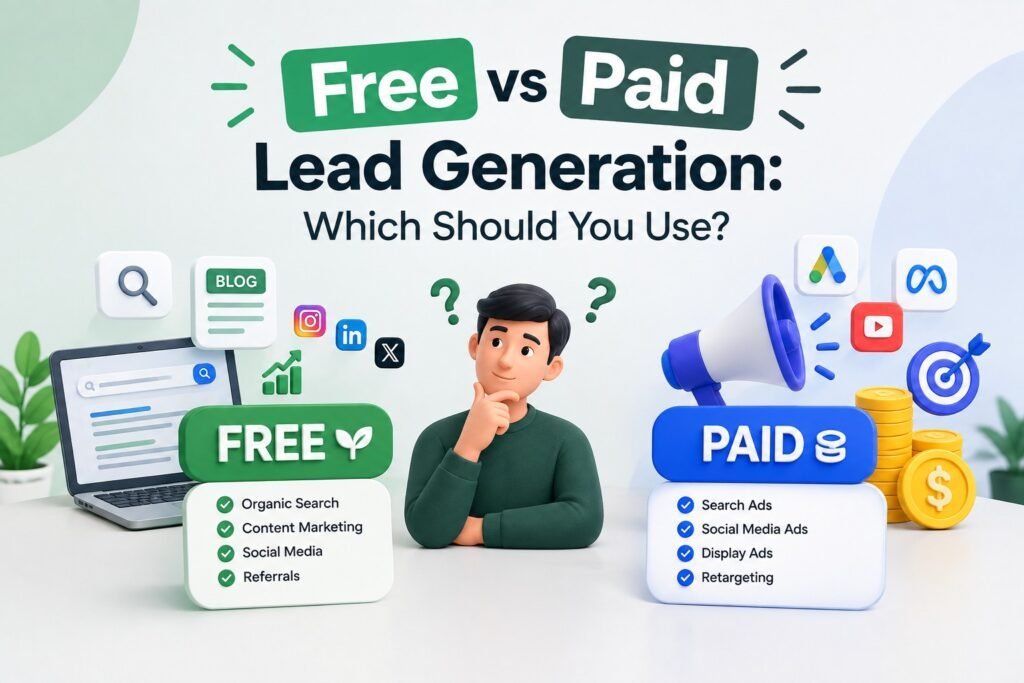
There is no universal answer.
Organic Lead Generation
Examples:
- SEO
- Blog content
- Social media
- Referrals
- Communities
- Partnerships
Advantages:
- Can compound over time
- Builds brand authority
- Can reduce dependence on advertising
- Creates reusable content assets
Limitations:
- Usually requires consistency
- Results may take time
- Competitive topics can be difficult
Paid Lead Generation
Examples:
- Search advertising
- Social media advertising
- Retargeting
- Sponsored content
Advantages:
- Can provide faster access to targeted audiences
- Easier to test specific offers
- Can scale when economics work
Limitations:
- Requires budget
- Performance depends on targeting and creative
- Poor campaigns can waste money
- Results can change when spending stops
For many businesses, a combination of organic and paid channels can provide a more balanced acquisition system.
10 Lead Generation Mistakes Businesses Should Avoid
Even a good strategy can fail because of poor execution.
1. Targeting Everyone
A message designed for everyone often feels relevant to nobody.
2. Having No Clear Offer
Visitors should understand what they can receive or do next.
3. Using Weak CTAs
“Submit” may be less informative than a specific action-based CTA.
4. Sending Every Visitor to the Homepage
Campaign traffic may perform better when directed to a relevant page.
5. Ignoring Mobile Users
Many prospects discover businesses on smartphones, so the experience must work well on smaller screens.
6. Not Following Up
A lead that never receives a response can quickly become a lost opportunity.
7. Buying Poor-Quality Leads
A large number of irrelevant contacts does not necessarily mean successful lead generation.
8. Ignoring Lead Quality
Track qualified leads and customers, not just form submissions.
9. Not Testing
Small changes to headlines, CTAs, offers, and landing pages can affect conversion performance.
10. Expecting Immediate Results
SEO, content, referrals, and other organic channels often require consistent effort.
How to Turn Online Leads Into Potential Customers
Generating a lead is only one part of the process.
You also need to understand whether the lead is a good fit.
Consider:
- Need: Does the person actually need your solution?
- Intent: Are they researching or ready to act?
- Budget: Can they realistically afford the solution?
- Timing: Do they need it now or later?
- Fit: Does your business actually serve their requirements?
This is why lead volume alone can be misleading.
For example, 500 unqualified leads may create more work than 50 highly relevant prospects.
Your objective should therefore be to improve both lead quantity and lead quality.
Tools You Can Use to Generate and Manage Leads Online
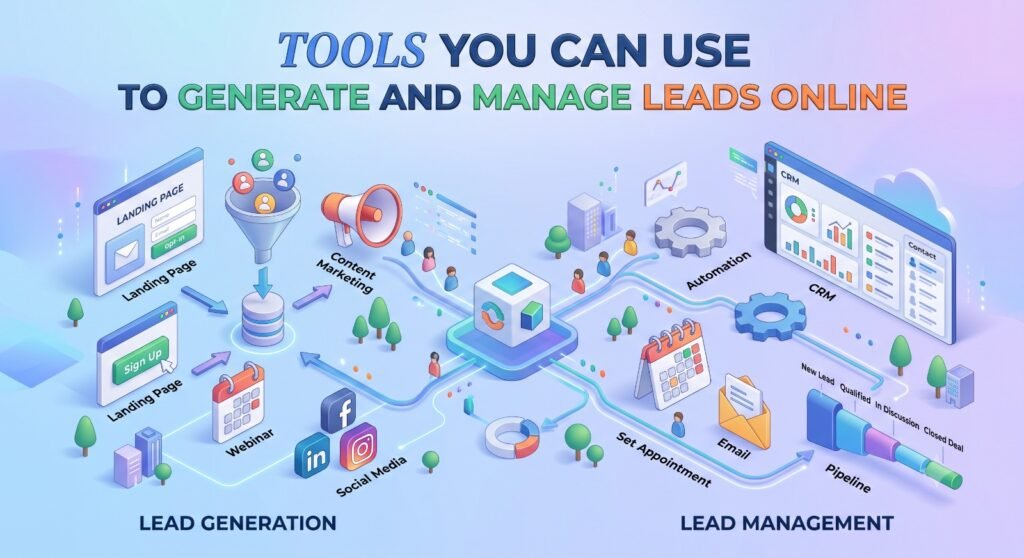
Different parts of the lead-generation process require different tools.
Analytics
Use analytics platforms to understand:
- Where visitors come from
- Which pages they visit
- What actions they take
- Which channels generate conversions
CRM
A CRM can help organize:
- Lead information
- Follow-ups
- Sales stages
- Conversations
- Customer history
Email Marketing
Email platforms can help manage:
- Subscriber lists
- Campaigns
- Automated sequences
- Lead nurturing
SEO Tools
SEO platforms can help with:
- Keyword research
- Competitor research
- Technical audits
- Content planning
- Search performance
Landing Page and Form Tools
These can help businesses create dedicated conversion experiences without rebuilding their entire website.
Choose tools based on your business size, budget, technical requirements, and workflow rather than simply choosing the most popular platform.
How to Measure Online Lead Generation
Tracking leads is important, but you should go beyond counting forms.
Number of Leads
The total number of leads generated during a period.
Qualified Leads
The number of leads that match your target customer profile and show meaningful buying intent.
Conversion Rate
A simple formula is:
Conversion Rate = (Number of Leads ÷ Number of Visitors) × 100
For example:
If 1,000 people visit a landing page and 50 become leads:
50 ÷ 1,000 × 100 = 5% conversion rate
Cost Per Lead
Cost Per Lead = Total Marketing Cost ÷ Number of Leads
This helps you understand how much you’re spending to generate each lead.
Customer Acquisition Cost
This measures the cost associated with acquiring customers rather than simply generating leads.
Lead-to-Customer Rate
This tells you how many leads eventually become customers.
For example:
100 leads → 10 customers
Lead-to-customer rate = 10%
These metrics help you understand where your marketing funnel needs improvement.
What Has Changed About Lead Generation in 2026?
Lead generation in 2026 is becoming less dependent on a single search engine or social network.
People can discover businesses through:
- Traditional search
- AI-powered search
- Social media
- Video platforms
- Maps
- Marketplaces
- Online communities
- Recommendations
Research published in 2026 shows that search behavior is becoming more fragmented across search engines, AI assistants, maps, marketplaces, and other platforms.
Google has also added reporting for multimodal searches in Search Console, including image-based experiences such as Lens and Circle to Search.
This means businesses should think beyond simply ranking one webpage.
A stronger approach is to build a recognizable presence across relevant channels and create useful information that can be understood by both people and modern search systems.
That does not mean publishing hundreds of AI-generated articles.
The focus should remain on useful, original information that genuinely helps the intended audience.
What Should You Do Next?
If you’re still wondering how to generate leads online, don’t try all 15 strategies at once.
Start with three steps:
Step 1: Define Your Ideal Customer
Be specific about who you want to attract.
Step 2: Choose Two or Three Acquisition Channels
For example:
SEO + Content + Email
or
Social Media + Referrals + Landing Pages
or
SEO + Paid Ads + Retargeting
Step 3: Measure the Entire Funnel
Track:
Visitors → Leads → Qualified Leads → Customers
Then improve the weakest stage.
For example, if you have plenty of traffic but few leads, work on your offers, landing pages, and CTAs.
If you have plenty of leads but few customers, look at lead quality, follow-up, qualification, and sales processes.
The goal isn’t simply to generate more activity. It is to build a system that consistently turns relevant attention into meaningful business opportunities.
Frequently Asked Questions
1. What is the easiest way to generate leads online?
There is no single easiest method for every business. Start by identifying where your target customers already spend time and what questions they ask. Content, social media, SEO, referrals, email, landing pages, and paid advertising can all generate leads when matched with the right audience and offer.
2. How can I generate leads without paid advertising?
You can use organic methods such as SEO, educational content, social media, email marketing, referrals, partnerships, communities, webinars, and useful lead magnets. These methods may require more time and consistency, but they can reduce dependence on advertising.
3. How do beginners generate leads?
Beginners should start with a clearly defined target audience, one useful offer, and one or two channels. For example, create helpful content, promote it through social media and search, and direct interested visitors to a simple landing page or contact form.
4. How do I get leads in digital marketing?
If you’re asking how to leads in digital marketing, begin by understanding your target audience and selecting channels where they are active. SEO, content, social media, email, paid advertising, referrals, and landing pages can all contribute to lead generation.
5. How do digital marketing agencies get clients?
Agencies can attract potential clients through educational content, SEO, social media, referrals, case studies, networking, partnerships, email outreach, webinars, and targeted advertising. Demonstrating expertise and understanding client problems is often more useful than simply promoting services.
6. How do I find leads for digital marketing?
When considering how to find leads for digital marketing, define your ideal customer first. Then identify relevant prospects through search engines, LinkedIn, business directories, industry communities, social platforms, networking, referrals, and existing professional relationships.
7. How can a digital marketing agency generate leads?
An agency can build a lead-generation system using useful educational content, organic search visibility, social media, case studies, lead magnets, email nurturing, referrals, partnerships, and paid campaigns. The specific combination should depend on its target market and acquisition economics.
8. How much does online lead generation cost?
The cost varies significantly by industry, audience, channel, competition, offer, and conversion rate. Organic channels can require more time than direct advertising, while paid campaigns require a financial budget. Businesses should measure cost per qualified lead and customer acquisition cost rather than focusing only on total lead volume.
9. How long does it take to generate leads online?
Some methods, particularly paid campaigns, can begin generating enquiries relatively quickly. SEO, content marketing, referrals, and organic social media often require more time and consistency. The timeline depends on competition, audience demand, offer quality, website experience, and execution.
10. What is more important: lead quantity or lead quality?
Both matter, but lead quality is essential. A large number of irrelevant leads can create additional work without producing customers. Businesses should track qualified leads, conversion rates, and customers alongside total lead volume.
Final Takeaway
Learning how to generate leads online is not about finding one magical marketing tactic.
It is about creating a system that:
Attracts the right audience → provides useful information → captures interest → builds trust → follows up → converts qualified prospects into customers.
In 2026, that system needs to account for a wider discovery environment that includes traditional search, social platforms, video, and AI-powered experiences.
Start small. Choose the channels that match your audience, create genuinely useful content, make your website easy to act on, and measure what happens after someone becomes a lead.
Consistency and continuous improvement matter more than trying every marketing tactic at once.